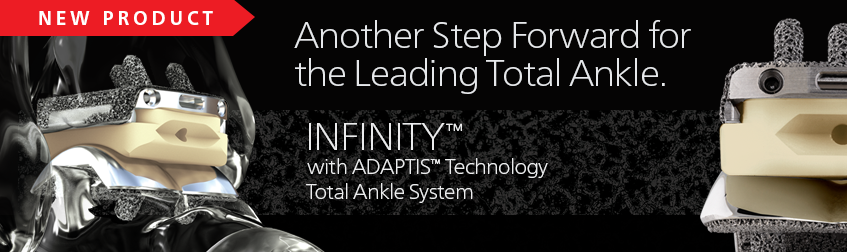

The Salto Talaris Total Ankle Prosthesis, which has been modeled after the human anatomy and is redefining the classic approach to ankle arthroplasty, is the leading total ankle replacement in the US.1 The innovative Salto Talaris provides surgeons the ability to reproduce the natural flexion/extension axis of the ankle with an anatomic design. The Salto Talaris implant design and instrumentation is founded on the Salto mobile-bearing ankle prosthesis, which has been in clinical use since 1997.
The Salto Talaris provides accuracy and reproducibility with the Precision Instrumentation that has evolved to allow a fixed-bearing implant design and represents the philosophy “Less is Sometimes More.”
The Salto Talaris Anatomic Ankle is a new generation ankle replacement that mimics the anatomy and flexion/extension movement of the natural ankle joint, and is an alternative to traditional ankle fusion.1
Advancements in orthopaedic technology continue to revolutionize surgical options. Today’s surgical instruments and implants make orthopaedic surgery more precise and more effective than ever before. One such advancement can now be seen in the Salto Talaris™, which has been modeled after the human anatomy and is positioned to redefine the classic approach to ankle arthroplasty.
The innovative Salto Talaris now provides surgeons with the ability to reproduce the natural flexion/extension axis of the ankle with an anatomic design. The Salto Talaris implant design and instrumentation is founded on the Salto mobile-bearing ankle prosthesis, which has been in clinical use since 1997 with a 93% survivorship at 6.4 year mean follow up2,3 and an 85% survivorship at 8.9 year mean follow up4. The Salto Talaris provides accuracy and reproducibility with the Precision Instrumentation that has evolved to allow a fixed-bearing implant design and represents the philosophy “Less is Sometimes More”

The Precision Instrumentation System was developed from the original Salto mobile-bearing design in order to restore the patient’s normal anatomy and obtain an optimal primary fixation of the components. The instrument system allows for accurate component positioning with tibial and talar preparations that are separate but codependent.
A key principle is that the mobile-bearing concept has been moved from the implant to the instrumentation at the stage of the trial reduction.
The trial tibial base, featuring a highly polished surface to remain mobile against the resected distal tibia, is allowed to rotate into proper position, thus self-aligning the prosthesis. After this optimal tibiotalar alignment is achieved, the preparation for the tibial keel and plug are completed
The talar resections are linked to the tibia and allow for a measured resection with equal implant replacement.
The precise guides for the 3 talar resections allow for an anatomic resurfacing of the talus with immediate stability.
The Salto Talaris Total Ankle Prosthesis is indicated as a total ankle replacement device in primary or revision surgery for the relief of pain and significant disability following arthritis and especially rheumatoid arthritis. It is also indicated for degenerative or post-traumatic arthritis.
1 Millenium Research Group, 2009
2 Donley, B. et al. New Ankle System Design Holds Promise. Cleveland Clinic-A Physician’s Newsletter from the Department of Orthopaedic Surgery, Fall 2006
3 Bonnin, M. et al. Midterm Results of the Salto Total Ankle Prosthesis. Clinical Orthopaedics & Related Research, 2004;424:6-18.
4 Bonnin M, Colombier JA, Judet T et al. The Salto Total Ankle Arthroplasty. Survivorship and Analysis of Failures at 7 to 11 years. Clinical Orthopaedics & Related Research, July 2010.
5 Bonnin M, Judet T, Piriou P, et al. Total ankle prosthesis: five to eight year results. Presented at the American Orthopaedic Foot and Ankle Society 22nd Annual Summer Meeting. July 14-16, 2006. La Jolla, CA.